Ever paid off a card in full and still seen interest on your next statement? Or bought something on the 2nd and had until the 27th to pay, while a friend with the same card seemed to get less time? Both come down to the billing cycle, a date range most people never look at.
Your billing cycle is the stretch of time between one statement closing date and the next. Cycles usually run 28 to 31 days, and each new one starts the day after the previous statement closes.
Everything you buy, every payment you make, and every fee that lands during that window gets bundled into one statement. That statement is the number your issuer asks you to pay.
Key takeaways
- Your billing cycle runs from one closing date to the next, usually 28 to 31 days. Everything you buy, pay, or get charged lands on one statement.
- The closing date and due date aren’t the same. Your issuer totals your balance at closing. Your payment is due later. The gap is your grace period.
- Federal law doesn’t force issuers to offer a grace period. If your card has one, though, it must be at least 21 days.
- Pay the full statement balance by the due date, and you usually owe no interest on new purchases. Pay less, however, and interest starts building. You may lose your grace period too.
- Cash advances and balance transfers work differently. Many issuers charge interest from day one.
- Early purchases give you more time. Buy on day one, and you get the rest of the cycle plus the grace period. Buy right before closing, and you only get the grace period.
- Most issuers report your balance around the closing date. So a high balance at closing can raise your utilization, even if you pay it off later.
- Every card runs on its own dates. If a due date keeps catching you off guard, ask your issuer to move it.
What is a billing cycle?
A billing cycle is the stretch of time your card issuer uses to track what you spend and owe. When it ends, everything inside it gets added up into one statement. Then a new cycle starts, and the count begins again.
Think of it like a restaurant tab that gets totaled on the same day every month. You can order whenever you like, but the bill only shows up once the tab closes. Each cycle usually runs 28 to 31 days, and anything you buy during that time lands on your next statement.
It isn’t just purchases that go into the pile, though. Payments, refunds, fees, and any interest charged all count too, so your statement shows the full activity of that stretch, not only what you bought.
Your cycle also doesn’t have to follow the calendar month. It might run from the 8th to the 7th, or the 19th to the 18th. Your issuer picks the dates, and you’ll find them at the top of your statement or in your card app. So if you hold two or three cards, each one can run on its own schedule. That’s worth knowing before you start planning payments.
Two dates come out of every cycle. The first is the statement closing date, when the tab gets totaled. The second is the payment due date, which usually comes a few weeks later.
That said, these two dates matter more than they seem, because interest, minimum payments, and even what shows up on your credit report all hang off them.
How a billing cycle works
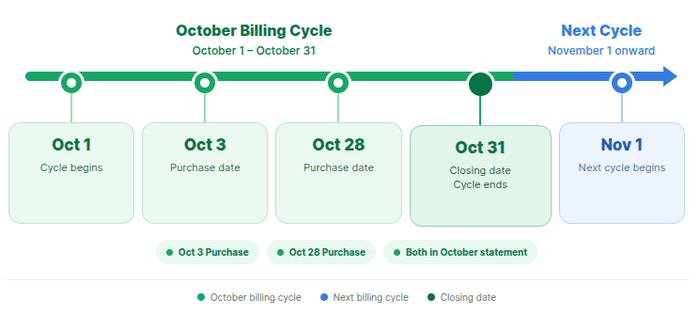
Take a cycle that runs from October 1 to October 31. You swipe your card for groceries, a phone bill, a pair of shoes. Whether you buy them on the 3rd or the 28th won’t make a huge difference, as they’re already in the same billing cycle. All of it lands on one statement.
On October 31, the cycle closes, and the issuer totals everything. A few days later, the statement shows up in your app or inbox. Not only does it list your balance, but it also gives you a minimum payment and a due date.
Then November 1 arrives, and you’re back to square one. However, your November purchases won’t appear on the October statement. So you can pay a bill in full and still see a “new balance” a week later.
That’s just the next cycle getting going. Therefore, the closing date is the one to watch, as it decides which statement each purchase belongs to, making it the most important date to keep in mind.
Statement closing date vs. due date
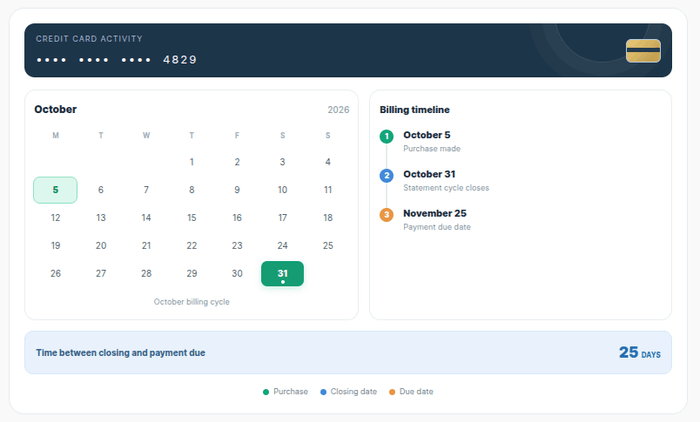
People mix these up constantly, and it costs them. The closing date is when the cycle ends. The due date is when your payment has to arrive. The gap between them is the grace period.
And a grace period is the time between the end of a billing cycle and the date your payment is due, and issuers must make sure your bill reaches you at least 21 days before that due date.
Many cards give a few extra days, so 25 isn’t unusual. If your cycle closes October 31 and your due date is November 25, you have 25 days to pay without interest on new purchases.
One catch worth knowing: federal law doesn’t force issuers to offer a grace period at all, but if they do, it must be at least 21 days. Your card agreement tells you what yours does.
Why your purchase date changes how long you have to pay
Here’s where the cycle gets practical. Two people can buy the same $400 jacket on the same card and get very different amounts of time.
Buy it on October 2, right after the cycle opens, and you have the rest of October plus the grace period before payment is due. That’s roughly 54 days from swipe to deadline.
Buy it on October 30, and you only get the grace period, about 26 days. TD Bank makes the same point, suggesting you time large purchases early in the cycle.
Either way, you pay no interest if you clear the full statement balance by the due date. Early in the cycle just gives you more breathing room.
How interest enters the picture
Pay the full statement balance by the due date, and you typically owe no interest on new purchases. Pay less, and interest starts building on what’s left.
It also usually means you lose the grace period on new purchases until you get back to a zero balance. However, the rules on getting that grace period back differ from one issuer to the next, so the CFPB suggests checking your card agreement for the exact wording.
That said, the billing cycle is the main part of this whole setup, since the grace period only makes sense in relation to it.
Cash advances and balance transfers are a different story. Many issuers start charging interest on those from the transaction date, with no grace period at all. So it doesn’t matter where you are in your billing cycle when you take one out, because the clock starts ticking right away.
Can you change your billing cycle?
Often, yes. Many issuers will move your due date if you ask. That’s handy when your paycheck arrives on the 5th, but your bill comes due on the 3rd, because you’re cutting it close every single month.
Moving the due date shifts the whole billing cycle, though, so don’t expect a clean swap overnight. Although the change won’t take long, you’ll probably see one odd statement, either shorter or longer than usual, while everything lines up.
It’s not as if your issuer made a mistake. The cycle is just adjusting. Call the number on the back of your card or check your account settings.
Where to find your dates
Open any recent statement. You’ll see a “statement closing date” (sometimes “billing period”) and a “payment due date.” Most card apps show both on the home screen.
If your cycle length matters to you, count the days between two closing dates. It should be close to the same length every month.
Small habits that make the cycle work for you
Set autopay for the full statement balance, and keep a calendar reminder for the due date anyway. Autopay can fail if your bank account is short.
Check your statement once a month, not just the amount but the dates. And if a due date keeps sneaking up on you, ask the issuer to move it.
That’s really all there is to it. Know when the cycle closes, know when payment is due, and the interest mostly takes care of itself.
FAQs
Most billing cycles run 28 to 31 days, and yours should stay about the same length each month. If you want the exact number, you can see your card agreement.
Not quite. The statement date, also called the closing date, is just the last day of the cycle. The cycle itself covers all the days that build up to it.
The closing date is the day your issuer sums up your balance. The due date is when your payment has to be in. The time between them is your grace period, and your issuer has to get the bill to you at least 21 days before the due date.
No. Federal law doesn’t require issuers to offer one, but if a card has one, it must be at least 21 days. Check your card agreement to see what yours does.
Usually not, as long as you pay the full statement balance by the due date. That’s what keeps new purchases interest-free. Cash advances and balance transfers play by different rules, though. Many issuers start charging interest on those from day one.
You avoid the late fee, but not interest. The minimum is usually 1% to 5% of your statement balance, and whatever remains keeps accruing interest.
Open your latest statement or open your card app. Near the top, you’ll spot the “statement closing date” or “billing period,” with the “payment due date” sitting close by. Can’t find them? Just call the number on the back of your card.
Some issuers let you change your cycle date; others won’t, and the options vary from card to card. Your best bet is to ask through the app or customer service. If they say yes, expect one cycle to run a bit shorter or longer while the switch kicks in.
Indirectly, yes. Most issuers report your balance to the credit bureaus around the closing date, not the due date. So a high balance at closing can push your reported utilization up, even if you pay it off in full afterward.
Paying before the due date keeps you interest-free and spares you late fees. Paying before the closing date does that too, and it also lowers the balance that gets reported.
However, paying in between still protects your payment history, but it can’t undo a high balance that’s already been reported.
Early in the cycle, if you want the most time to pay. A purchase made on day one gets you the rest of the cycle plus the full grace period before the bill comes due. One made right before closing only gets you the grace period, so you’re paying much sooner.
Yes. Every card runs on its own dates, even when two come from the same issuer. If you carry several, jot down each closing and due date in one place, so nothing slips through the cracks.